A telehandler forklift serves as a hybrid between a traditional rough-terrain forklift and a small crane. When contractors face elevated loading requirements, choosing between a straight-mast rough-terrain forklift and…
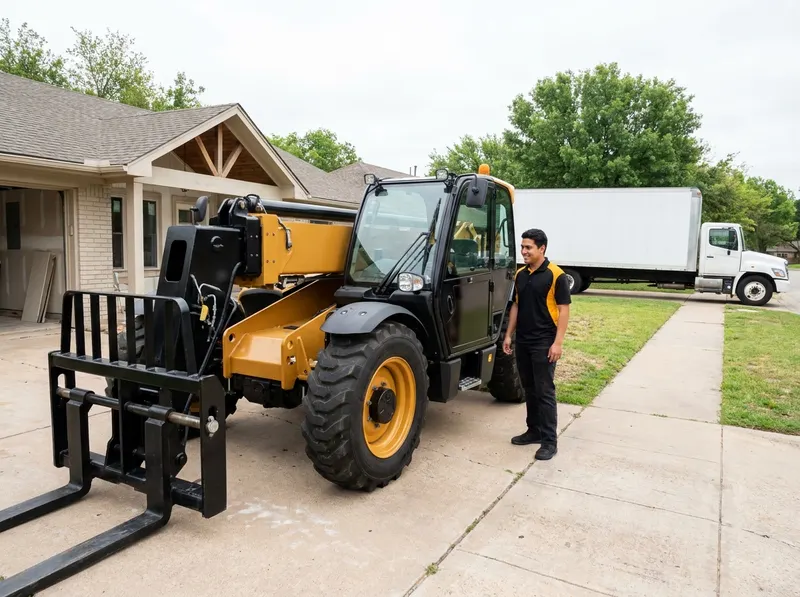
A telehandler forklift serves as a hybrid between a traditional rough-terrain forklift and a small crane. When contractors face elevated loading requirements, choosing between a straight-mast rough-terrain forklift and a telescopic handler comes down to forward outreach. A straight mast lifts loads only vertically, requiring the tires to sit right against the scaffolding or trench. In contrast, a telehandler extends outward across mud, foundation trenches, and low-rise parapet walls to place pallets directly where crews are standing. For multi-story commercial framing near Alliance or historical retrofits in the Fairmount Historic District, reach capacity dictates project tempo. A compact 5,500-lb telehandler with a 19-foot reach navigates narrow side yards and zero-lot-line residential streets, whereas a 10,000-lb unit reaching 56 feet handles heavy structural steel for commercial framing near the Camp Bowie District or industrial builds along Riverside.
Tarrant County soil shifts rapidly between wet Trinity River clays and dense caliche base. Standard warehouse forklifts sink immediately on unpaved ground, whereas rough-terrain telehandlers use four-wheel drive, three steering modes, front-wheel, coordinated four-wheel, and crab steer, and foam-filled or pneumatic lugged tires to prevent immobilization. On sites bordering Clearfork and TCU-Westcliff, operators utilize frame-leveling hydraulic sway systems to compensate for ground slopes up to 10 degrees before extending the boom upward, ensuring load charts remain stable and secure. The main trade-off of a telehandler is ground surface footprint: while these machines maneuver over raw dirt, an empty 10,000-lb unit exerts upwards of 28,000 lbs of operating weight. Staging a heavy machine on residential asphalt in Alamo Heights or Marine Creek Ranch without ground-protection track mats can crack unreinforced residential driveways, which is why commercial deliveries plan firm drop zones.
Dispatching the right machine requires matching actual gross material weights to the boom load chart at full forward extension. For example, a telehandler rated for 8,000 lbs can only hoist that full weight while retracted close to the chassis; extending the boom 30 feet forward cuts safe carrying capacity down to roughly 2,000 lbs. If a roofing crew near Stop Six attempts to boom full bundles of commercial polyiso insulation and modified bitumen rolls past a 40-foot building set-back, undersizing the machine causes immediate stability shutdowns. Booking direct through local dispatch eliminates the standard 15% to 25% middleman broker surcharges, providing verified machinery dispatched on dedicated lowboy trailers directly to your staging perimeter.
Every job gets a firm, written price after a free on-site visit.
Tell us about your telehandler forklift rentals job in Fort Worth and we'll send a clear, written quote, usually the same day.
 First Coast Dumpster Rental